Save 20% on your first session
Mindful Meditation as Taught by Gautama the Buddha: A Path to Awareness and Inner Freedom
5/15/20263 min read
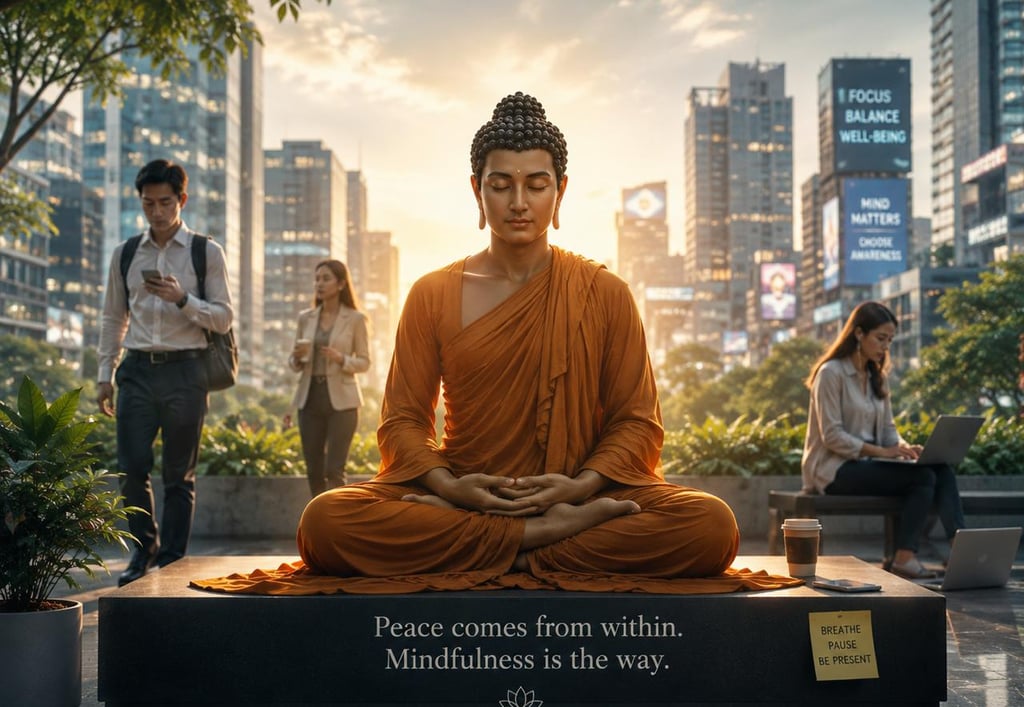
In today’s fast-moving world, the mind rarely rests. We worry about the future, replay the past, compare ourselves with others, and often feel trapped in stress and emotional turbulence. More than 2,500 years ago, a man deeply explored this human struggle and discovered a practical way out. That man was Gautama Buddha.
The mindful meditation taught by Buddha was not meant as an escape from life. It was a method to understand the mind, reduce suffering, and experience reality clearly. His teaching was simple yet profound: suffering does not come only from circumstances; it also arises from how the mind reacts to them.
What is Mindful Meditation?
Mindful meditation is the practice of bringing full awareness to the present moment without judgment. It means observing thoughts, feelings, bodily sensations, and experiences as they arise and pass away.
According to Buddha, most people live on "automatic mode." The mind constantly wanders between memories of the past and worries about the future. Mindfulness brings attention back to what is happening right now.
This awareness is not forced concentration. It is a gentle observation.
Imagine sitting beside a river and watching leaves float by. You do not chase them or stop them. You simply observe. In the same way, thoughts are noticed rather than controlled.
Buddha’s Discovery: Why Humans Suffer
Before teaching meditation, Buddha first explored a deeper question: Why do humans suffer?
He observed that people become attached to pleasure, resist pain, and hold tightly to identities and expectations. Since life constantly changes, this attachment creates dissatisfaction.
Mindfulness was his practical answer.
Through careful observation, a person begins noticing:
Thoughts are temporary
Emotions rise and fade
Sensations change continuously
Experiences are constantly shifting
This insight slowly weakens fear, craving, and inner conflict.
The Practice of Mindfulness of Breath
One of Buddha's foundational meditation practices is awareness of breathing.
The process appears simple:
Sit comfortably with a straight posture
Relax the body
Bring attention to the natural breath
Observe inhalation and exhalation
When the mind wanders, gently return attention
No need to force breathing.
No need to stop thoughts.
The goal is awareness—not perfection.
At first the mind may wander hundreds of times. Buddha compared the untrained mind to a restless monkey jumping from branch to branch. Meditation is the gradual training of attention.
The Psychological Power of Mindfulness
Modern psychology increasingly confirms many observations made by Buddha centuries ago.
Mindfulness can help individuals:
Reduce stress and mental overload
Improve emotional regulation
Increase attention and focus
Develop self-awareness
Respond thoughtfully rather than react impulsively
When awareness increases, a person begins noticing the gap between stimulus and reaction. Within that small gap lies freedom.
Instead of anger controlling us, we observe anger.
Instead of anxiety carrying us away, we notice anxiety.
Awareness creates choice.
Meditation Is Not Escaping Life
Many people assume meditation means withdrawing from the world. Buddha taught something different.
Mindfulness is not running away from responsibilities. It is learning how to live more consciously.
You can practice mindfulness while:
Walking
Eating
Listening
Working
Studying
Speaking with others
The purpose is to bring presence into ordinary life.
Meditation does not remove all problems instantly. Rather, it changes the way we relate to them.
The Ultimate Aim: Inner Freedom
For Buddha, mindful meditation was more than relaxation.
Its deepest purpose was liberation from ignorance, unconscious habits, and suffering. Through continuous observation, a person gradually sees reality clearly and develops wisdom.
Freedom, according to Buddha, was not freedom from the world.
It was freedom from automatic reactions, attachments, and the restless patterns of the mind.
Even today, in a world filled with distractions, his teaching remains surprisingly relevant:
Pause.
Breathe.
Observe and Feel
Return to the present moment.
Because sometimes the greatest journey is not outward—it is inward.
At My Mindful Master, we believe mindfulness is not just a technique but a way of understanding ourselves. Through awareness, guidance, and practice, we help individuals cultivate focus, emotional balance, and a more fulfilling life.